How-to
7 Questions to Ask Before Placing a Bulk Stainless Order

Shreyansh Bhansali and Krisha Mutta

Overview
Procuring stainless steel pipes and tubes at scale is one of the most critical decisions an engineering or procurement team makes. Having supplied critical piping solutions for decades to sector leaders like ADNOC, ONGC, BARC, and Bayer, we’ve seen firsthand how a single sub-par shipment can lead to costly project delays, severe corrosion, or unexpected plant shutdowns.
Buying stainless steel in bulk is about far more than just comparing cost-per-ton on a spreadsheet. To protect your budget, project timeline, and operational integrity, ask your manufacturer or supplier these seven non-negotiable questions before signing off on a bulk purchase order.

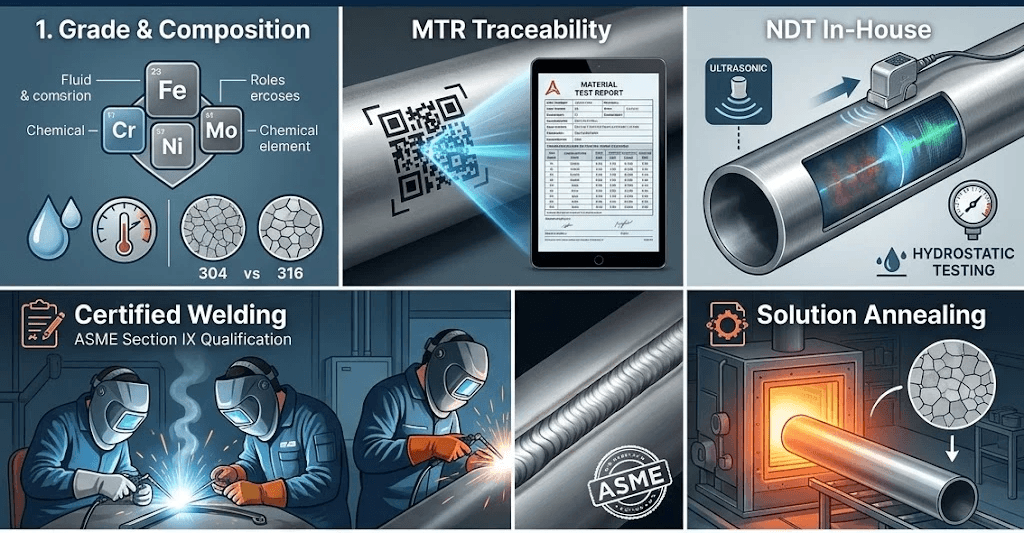
1. What Exact Grade and Chemical Composition Are You Supplying?
Not all stainless steel is created equal. Even within standard categories like Austenitic (300-series) or Ferritic (400-series), slight variations in chemical elements like Nickel, Chromium, and Molybdenum dramatically alter how the metal behaves in aggressive environments.
For instance, substituting Grade 304 for Grade 316 in marine environments or offshore rigs will lead to severe pitting corrosion down the line due to the lack of Molybdenum.
What to ask: Ask for a full chemical analysis and material specification breakdown to ensure the grade supplied matches your exact fluid and temperature parameters.
2. Can You Provide Mill Test Reports (MTRs) Traced to Every Batch?
A Material Test Report (MTR) or Mill Test Certificate (MTC) is the official identity card of your steel shipment. It verifies chemical composition, yield strength, tensile strength, and heat numbers.
In high-stakes sectors like nuclear power or offshore energy, generic or untraceable certificates pose severe safety risks. Unscrupulous traders sometimes bundle mixed-grade stock or provide certificates that don't match physical heat numbers.
What to ask: "Will every bundle and pipe carry heat-number markings that directly match digital, heat-traceable Mill Test Reports?"
3. What Non-Destructive Testing (NDT) Methods Do You Perform In-House?
Visual inspection alone cannot detect micro-cracks, internal porosity, or weak weld seams in ERW or EFW pipes. To handle continuous pressure in refineries and chemical synthesis plants, your manufacturer must conduct rigorous in-house NDT testing.
What to ask: Ensure your supplier utilizes essential testing protocols such as:
Hydrostatic Testing: Checking structural and pressure integrity under full water load.
Eddy Current or Ultrasonic Testing: Scanning the full seam length for hidden internal defects.
Pre-Dispatch Inspection (PDI): Verifying wall thickness, outer diameter (OD) tolerances, and end beveling.
4. Are Your Welding Procedures and Operators Certified to ASME Standards?
For heavy-wall or large-diameter piping, seam welding quality dictates the operational life of the entire pipeline. Uncertified welding procedures create stress corrosion cracking, joint degradation, and premature leaks.
What to ask: Ask if the manufacturer’s welding procedures and welders are qualified under ASME Section IX (or equivalent global codes). Certified processes guarantee that heat inputs, filler metals, and joint preparations adhere to strict safety standards.
5. What Is Your Installed Annealing and Heat-Treatment Setup?
During cold-forming or welding, internal mechanical stresses accumulate and carbide precipitation can reduce the metal's natural corrosion resistance. Solution annealing (heating steel to high temperatures followed by rapid quenching) restores ductility and maximum corrosion protection.
What to ask: Confirm whether the facility utilizes continuous, modern solution-annealing furnaces capable of processing your specific order volume smoothly without scaling or oxidation.
6. What Are Your Real Lead Times and Monthly Production Capacities?
Supply chain bottlenecks can halt an entire project site. Traders often take on bulk orders that exceed their actual fulfillment capacity, leading to staggered shipments, project delays, and financial penalties.
What to ask:
"What is your current active output versus total annual capacity?"
"How much buffer room is allocated for unexpected production delays?" Partnering directly with established manufacturers operating out of major industrial hubs (such as Boisar-Tarapur MIDC) ensures reliable raw material staging, direct logistics access, and predictable delivery schedules.
7. What Packaging and Transit Protocols Do You Follow for Long-Distance Deliveries?
Even high-grade stainless steel can sustain surface damage or contamination during sea freight or long-distance transit. Moisture exposure can cause surface staining, while improper bundling can bend pipe ends or ruin polished finishes.
What to ask: Ask how the pipes are prepared for transport:
Are plastic end-caps fitted to protect bevels and pipe interiors from dust and moisture?
Are bundles wrapped in protective HDPE or wooden crates for international shipping?
How are different metal grades separated during transport to prevent cross-contamination?
Partnering with Proven Manufacturing Experience
Placing a bulk stainless order shouldn't feel like a gamble. By asking these seven targeted questions early in your procurement process, you can weed out unreliable traders and partner with transparent, quality-focused manufacturers who stand behind their metal.
At Aaditya Stainless, our 30+ year track record, 6,000 MT/annum capacity, in-house testing setup, and ASME Section IX qualified processes ensure every shipment meets exact project specifications—every single time.